Treatment
Type 1 diabetes cannot currently be cured and requires lifelong treatment, which demands considerable effort from the patient and those around them. It can only be treated with insulin. Strict blood sugar control, keeping levels within the normal range, matters not only to suppress symptoms in the short term but also to prevent later complications. At the same time, blood sugar must not drop too low, as this risks hypoglycaemia, or a 'hypo' for short.
Your type 1 diabetes is not the result of an unhealthy lifestyle. Even so, living healthily is very important for you. A healthy lifestyle means:
- Not smoking
- A balanced diet
- Enough physical activity
- Losing weight if you are overweight
There are various ways to measure blood sugar: strips and a finger prick, a flash glucose monitoring system (FGM) or a continuous glucose monitoring system (CGM). Your doctor can discuss the options with you.
Insulin injections with a pen
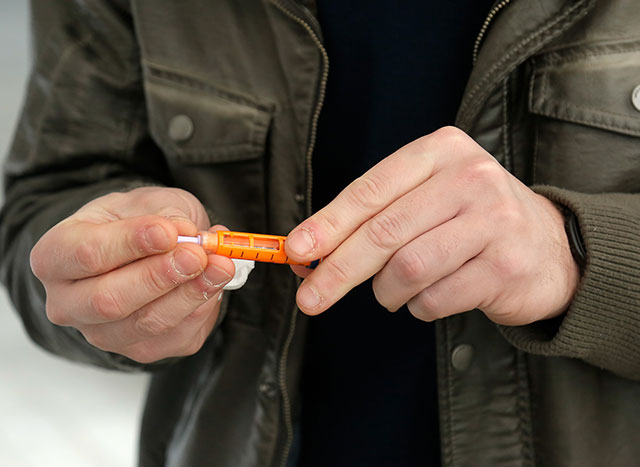
A pen lets you dose and inject insulin. Both disposable and refillable pens exist. Insulin therapy has advanced considerably in recent years. Today there are ultra-fast-acting and long-acting insulin analogues with a number of important advantages. Because the fast-acting forms are absorbed more quickly, patients can also take them after a meal, depending on how much they have eaten.
Insulin pump
An insulin pump is a device measuring 6 by 4 cm that delivers the programmed amount of insulin through a catheter in the abdomen to keep blood sugar levels steady, mimicking the natural function of the pancreas. The pump does not measure blood sugar, so a standard blood glucose meter or sensor is still needed.