Does the Koolhydraatteller app use AI?
How AI works in a nutrition app
AI stands for artificial intelligence. AI systems are autonomous 'smart' systems that can 'learn' on their own by finding connections between data and labels. So an AI system for a nutrition app has to be given many examples, for instance photos of meals on the one hand and labels (the description of the meal; the outcome) on the other. AI can also be used to derive new information from what you enter, such as estimating how much a scanned food item weighs, or its number of calories or grams of carbohydrate.
There are also AI systems that calculate your requirements on the basis of your personal data (age, weight, the goals you have set), support you in reaching those goals and suggest recipes based on your preferences, for example. Although this is not a true AI application, but rather something based on the preferences and wishes you enter, basic calculations and an underlying database.
The study by Li et al (2024), which compared nutrition apps with and without AI, found that apps with AI integration offered better functionality but that the estimate of energy content was inaccurate, particularly for composite meals. In the average nutrition app, carbohydrate intake was overestimated by 20% of energy intake. The study also notes that it worked with ideal conditions of lighting, a clear background, the same distance and an ideal angle for taking the photo and estimating portions that way. In real life these conditions are hard to achieve, which means the deviation can be greater.
Possible advantages of AI systems:
- Determining portion sizes, so that you no longer have to enter grams or portions; it does remain an estimate, however, and is not yet fully exact. Factors such as lighting and background have an influence.
- Recognising foods. This works mainly for easily recognisable, minimally processed products: a slice of bread, boiled potatoes on the plate, an apple, and so on.
- It can sometimes suggest menu ideas based on your favourite dishes.
What an AI system cannot do yet:
- The underlying nutritional information still has to come from a food database. The photo scanner cannot yet analyse the nutritional value of meals from a photo alone.
- Composite meals such as spinach purée, spaghetti bolognese, jam or a pancake cannot be broken down into their components: the nutritional value can differ depending on the proportions used (more or fewer vegetables), the amount and type of cooking fat, the addition of sugar, cream, and so on.
- An AI system cannot distinguish the 'invisible' additions such as sugar, honey, salt, cream or oil used during preparation. For instance, an AI system cannot yet tell the difference between a classic jam and a reduced-sugar jam, or between a cake made with sugar and one made with sweeteners.
- When giving advice, an AI system cannot take into account your blood glucose level, stress level, activities (or the planning of those activities), and so on.
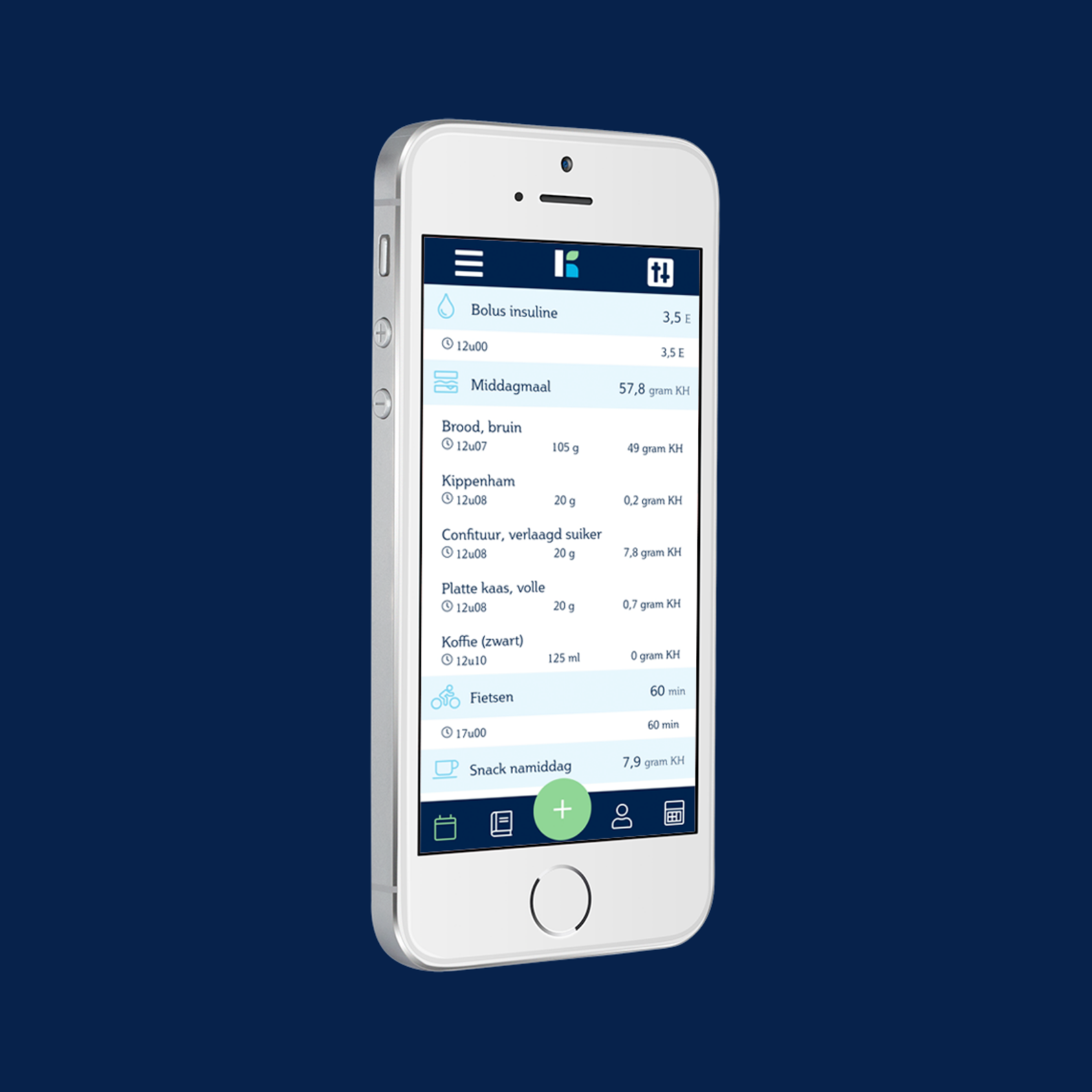
Does the Koolhydraatteller app use AI too?
At present the Koolhydraatteller app does not yet use AI, and the food database is subject to human checking. Photo recognition is not built into the app. At this stage it does not yet deliver the desired results for all types of meals and products. With diabetes it is especially important that the estimated amount of carbohydrate is reasonably accurate, and most apps cannot yet take account of all your parameters, nor of active insulin, stress levels, (planned) activities, illness, and so on.
The advantage of the Koolhydraatteller is that the app is a genuinely Belgian product. It includes products from the Belgian food database, an in-house sports nutrition database, and is further supplemented with branded products. New products are added to the app every day, with portion sizes and terms as they are used in Belgium, and under the supervision of a dietitian.
Behind the scenes, the developers of the Koolhydraatteller are looking into how AI could be used to keep the food database up to date and accurate, so that searching within the app stays as user-friendly as possible.
What are the future possibilities of AI in the Koolhydraatteller?
In future the Koolhydraatteller wants to invest in AI possibilities for building and maintaining the food database. Individuals, companies and organisations interested in contributing can get in touch with erika.vanhauwaert@ucll.be and danny.volkaerts@ucll.be
Sources:
Li X. et al (2024) Evaluating the quality and comparative validity of manual food logging and artificial intelligence-enabled food image recognition in apps for nutrition care. Nutrients, 16, 2573
Authors: Erika Vanhauwaert & Danny Volkaerts (UCLL)